I’ve spent 15 years building an agency, working with brands of all sizes, and watching marketing reinvent itself more times than I can count. And I love it. New technology, new platforms, new ways to reach people. The possibilities today are extraordinary, and I still get excited about what’s next.
But for all the changes I’ve witnessed, there’s one principle I’ve believed in since the beginning. It’s something I say often, both inside my agency and outside of it:
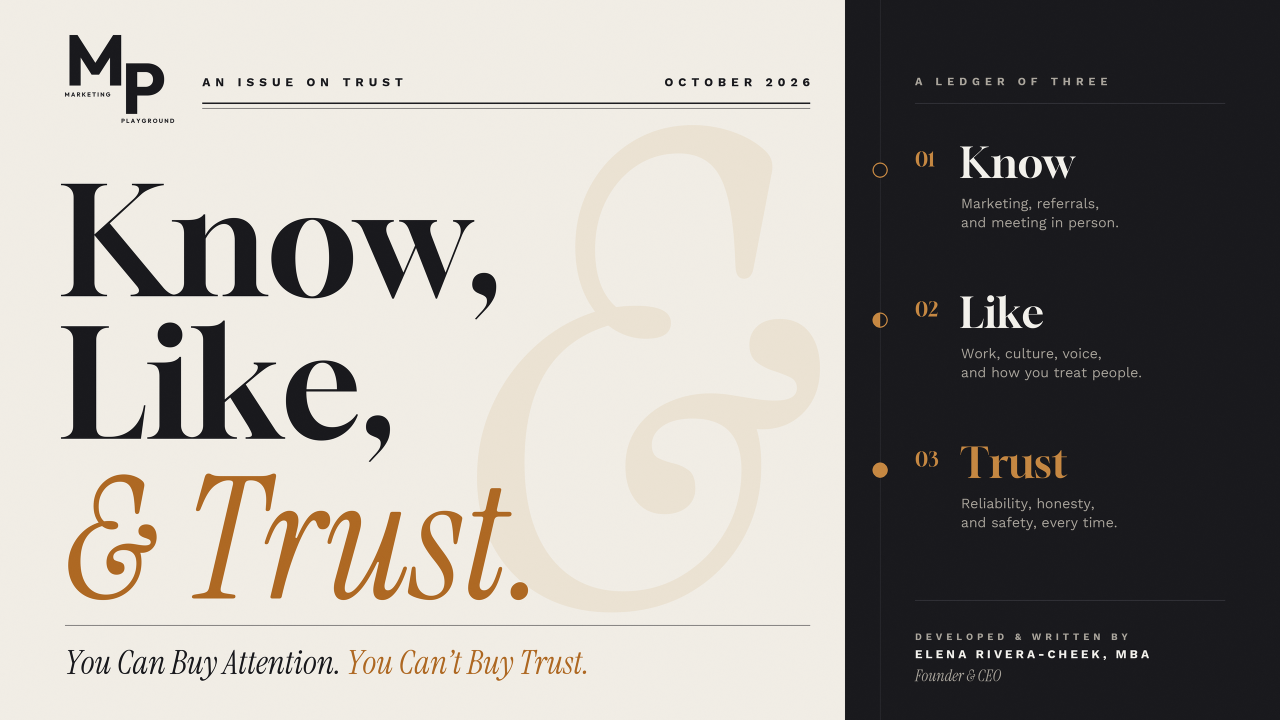
People do business with, build careers with, and buy from people they KNOW, LIKE, and TRUST.
Three words. Nothing revolutionary, but I’d argue they’re more important today than ever. Think about how much time, money, and energy businesses invest in getting noticed. We chase impressions, clicks, followers, leads, and conversions. We invest in technology that promises to help us reach more people, more efficiently. And now AI has made producing content faster and easier than ever.
But once you’ve gotten someone’s attention, have you given them a reason to choose you? Getting noticed and getting chosen are two very different things, and understanding that distinction can change the way you approach marketing. Let’s look at what it really takes:
1. KNOW: Being Visible Isn’t the Same as Being Known
You can have a beautiful website, an impressive social presence, and a substantial advertising budget, but does your audience actually know who you are? Do they understand what you do, what makes you different, and why they should care?
In my experience, people get to know a business in three primary ways: through what the business puts into the world, including its marketing, content, advertising, and thought leadership; through what other people say about it, including referrals, recommendations, and good old-fashioned word of mouth; and through personal interactions with the people in and behind the brand.
What’s interesting is that people are increasingly forming opinions about your business long before you have an opportunity to meet them.
According to the 2025 Edelman and LinkedIn B2B Thought Leadership Impact Report, 71% of hidden buyers, the people influencing purchasing decisions behind the scenes, have little or no interaction with a vendor’s sales team.
Consider what that means for your business. People who may influence whether your company wins or loses an opportunity are getting to know you without ever speaking to you. They’re reading your content, watching your videos, asking colleagues for recommendations, and forming impressions based on what they find.
Your reputation is in the room, whether you are or not.
That’s why I believe great marketing isn’t simply about being everywhere. It’s about being recognizable, relevant, and memorable to the people who matter. Visibility creates an opportunity, but being genuinely known is what gets you considered.
2. LIKE: People Remember How You Make Them Feel
Just because someone knows your brand doesn’t mean they like it. And in a competitive marketplace, being liked matters more than some marketers care to admit.
I’m not suggesting that every brand needs to be charming, funny, or everyone’s best friend. I’m talking about something more substantial. Does your brand resonate with the people you’re trying to reach? Do your values align? Is your work compelling? Do people enjoy their interactions with your company?
I’ve always believed that how a company operates internally eventually becomes visible externally. Your clients, employees, partners, and the people who support your business all contribute to how your brand is perceived.
Research supports that connection. The 2026 Edelman Trust Barometer CEO Insights found that 51% of respondents say what employees say about a CEO most shapes their opinion of that leader. That’s a compelling argument for paying attention to culture, and a reminder that your brand is shaped by much more than your marketing department.
At C&A, we’ve been fortunate to work with some incredible clients over the years. One of the compliments that means the most to me isn’t about a campaign, a design, or a deliverable. It’s when clients tell us how much they love working with our people. Their energy, their integrity, and their genuine care for the client and the work.
Of course, the quality of our work matters. It has to. But there are plenty of talented agencies out there, and I know that. What makes someone want to work with you again? What makes them recommend you to someone they respect?
Very often, it’s the experience. People may initially hire you for what you do, but the way you do it plays an enormous role in whether they come back. That’s not just good customer service. It’s brand equity, and it’s something every business should be deliberately building.
3. TRUST: The Hardest to Earn and the Easiest to Lose
You can know a brand and not particularly like it. You can like a brand and still hesitate to give it your business. But when you know a brand, like what it stands for, and trust it to deliver, you’ve created something incredibly valuable.
Trust isn’t built through a clever tagline or a beautiful brand campaign. It’s built when the promise matches the experience, consistently and over time. In Edelman’s 2026 Trust Barometer Special Report on Brands, 88% of respondents said trusting a brand was an important or critical consideration, virtually equal to product quality at 89% and value at 88%.
I find that fascinating because we spend so much time talking about price, quality, and differentiation, yet trust ranks right alongside them. It deserves the same level of strategic attention.
I’m a big believer in technology and the opportunities AI creates. We should absolutely be exploring how to use it to make our work smarter, more effective, and more valuable. But there’s a difference between using technology to make better marketing and using it simply to make more marketing. Consumers are becoming increasingly aware of that distinction.
You can buy reach, impressions, and visibility. You can invest in getting your brand in front of exactly the right audience. But none of those investments guarantees that someone will believe what you’re telling them. That confidence has to be earned through the experience you deliver.
When Trust Breaks: The Wells Fargo Lesson
Consider Wells Fargo. Founded in 1852, the company spent more than a century building one of the most recognizable names in American banking. Then came the fake-accounts scandal.
In 2016, regulators revealed that employees, driven by aggressive sales targets and incentives, had opened approximately 1.5 million deposit accounts and applied for roughly 565,000 credit cards that customers may never have authorized. By 2020, the bank had agreed to pay $3 billion to resolve criminal and civil investigations into its sales practices.
More than 160 years of history, enormous brand recognition, and substantial brand equity were undermined by the company’s own behavior.
Wells Fargo responded with its 2018 “Re-Established” advertising campaign, acknowledging past failures and promising change. But advertising could only communicate the promise. It couldn’t fulfill it. The Federal Reserve imposed restrictions on the bank’s growth in 2018, and those restrictions weren’t lifted until June 2025, more than seven years later.
During that period, Wells Fargo made significant leadership and operational changes in its efforts to rebuild credibility. The lesson for marketers is worth remembering: advertising can tell people that a company has changed, but only consistent behavior can convince them it’s true.
No campaign, no matter how beautifully executed, can substitute for integrity, accountability, and performance. Trust takes time to build, can disappear remarkably quickly, and may take years to earn back.
Sources: Consumer Financial Protection Bureau, U.S. Department of Justice, Federal Reserve.
And Here’s Where It Gets Personal
Everything we’ve talked about applies to you, too. Not just the company you own or the brand you represent, but your career, your reputation, and your personal brand.
Think about the people who have opened doors for you throughout your career. The people who hired you, promoted you, recommended you, brought you into an important meeting, or gave you an opportunity you weren’t expecting. Why did they choose you?
Chances are, they knew your work, liked working with you, and trusted you to deliver. Those same three principles that influence purchasing decisions also shape professional opportunities.
I’ve seen incredibly talented people struggle to advance because they overlooked one of those three things. I’ve also watched others build remarkable careers because they understood that reputation is something you earn every day, not something you create when you’re ready for your next opportunity.
Here’s something I often think about as a business owner: your reputation is being shaped in meetings you’re not attending, through conversations you’re not hearing, and by experiences you may never know took place. That’s true for businesses, and it’s equally true for people.
Whether you’re trying to win a new account, earn a promotion, build a business, or establish yourself as a leader in your field, the same three words apply. You don’t need a massive following to build a remarkable career. You need the right people to know who you are, value what you bring, and trust you to deliver. Then you need to keep earning that confidence.
Your Playground Challenge
This month, I want to leave you with a little exercise. Think about two brands: the company you represent and the personal brand you’re building. Then consider these three questions for each.
- KNOW: Do the right people know who we are, what we do, and what makes us different?
- LIKE: Do people genuinely enjoy working with us? Do our values, culture, and behavior give them a reason to choose us?
- TRUST: Are we/am I delivering on our promises consistently enough to earn people’s confidence?
Now, which of the three needs the most work? That’s probably where your next investment of time, attention, and energy belongs.
Marketing will continue to evolve. The tools will change, the platforms will change, and the technology will certainly change. But the fundamentals of human relationships remain remarkably consistent, and I don’t see that changing anytime soon.