Welcome back to the Marketing Playground! This month, I want to talk about a problem hiding in plain sight — one that affects every brand, every marketer, and every dollar we spend to get noticed.
Modern marketing disappears.
Not slowly. Not over months. In many cases, it disappears in hours. A LinkedIn post — the platform most of us rely on for professional visibility — has a half-life of 23 hours. Instagram: 18 hours. A tweet can peak and vanish in under 15 minutes. That white paper you spent weeks producing? It gets downloaded, maybe skimmed, and forgotten. The average person is now exposed to more than 10,000 ad impressions every single day, and our brains have learned to do what any rational system would: filter almost all of it out.
The data on this is staggering. Average human attention span has dropped to 7.6 seconds — a 37 percent decline since 2000. Banner blindness affects 70 percent of online users. Click-through rates on digital ads drop 50 to 70 percent within weeks of launch as audiences tune out repetitive creative. And here is the stat that should trouble every CMO: 67 percent of consumers now report experiencing marketing fatigue, and 57 percent have switched to a competitor specifically because they felt overwhelmed by a brand’s messaging.
We are spending more than ever to be seen, heard, and remembered — and the shelf life of that investment is measured in hours.
The Old-School Solution to the New-School Problem
So what if the answer is not faster, louder, or more frequent? What if the most powerful marketing asset available to your organization is one that has existed for centuries?
A book.
Not a blog post. Not an e-book lead magnet. A real, published book with your company’s name on it, your ideas inside it, and your point of view shaping how your market thinks about the problem you solve.
While a social post dies in a day, a business book has an average active-use lifespan of eight years. It sits on a shelf, gets handed to a colleague, gets quoted in a board meeting, gets assigned in an MBA program. It does not depend on an algorithm to be discovered. It compounds. And in an era when trust is collapsing — when 91 percent of consumers say ads have become more intrusive and 70 percent have unsubscribed from at least three brands in the past three months — the data shows that deeper content earns what surface-level content cannot. According to the Edelman-LinkedIn B2B Thought Leadership Impact Report, 73 percent of executives consider thought leadership more trustworthy than traditional marketing. And 75 percent of decision-makers say they have explored products or services they were not previously considering after engaging with a company’s thought leadership.
A book is thought leadership in its most concentrated, most durable, most trust-building form.
What a Book Does for an Organization
The companies that understood this earliest used books not as vanity projects but as strategic brand assets. HubSpot’s founders published Inbound Marketing in 2009 — not a book about their software, but a book that named an entire category. It defined the language an industry would use for the next fifteen years and turned a startup into the company that meant inbound. Basecamp published Rework, a New York Times bestseller that positioned the company as the voice of a movement and attracted exactly the kind of customers and employees who shared their philosophy.
These were not personal projects. They were organizational decisions that paid compounding returns.
Here is what a book does that campaigns today struggle to accomplish:
- It differentiates in ways a deck never will. A book forces you to articulate what you believe, how you think differently, and why it matters — in a format the market takes seriously
- It sells. Seventy percent of B2B decision-makers say thought leadership has led them to question an existing supplier. A book placed in a prospect’s hands before the first meeting means you are no longer pitching. You are the company that literally wrote the book
- It attracts the right people. Eighty-six percent of job seekers research a company’s culture and values before applying. Companies that share quality thought leadership are 58 percent more likely to attract talent. A book tells the market who you are and what you stand for — the people who show up already believe in the mission
Why We Put Our Story on the Shelf
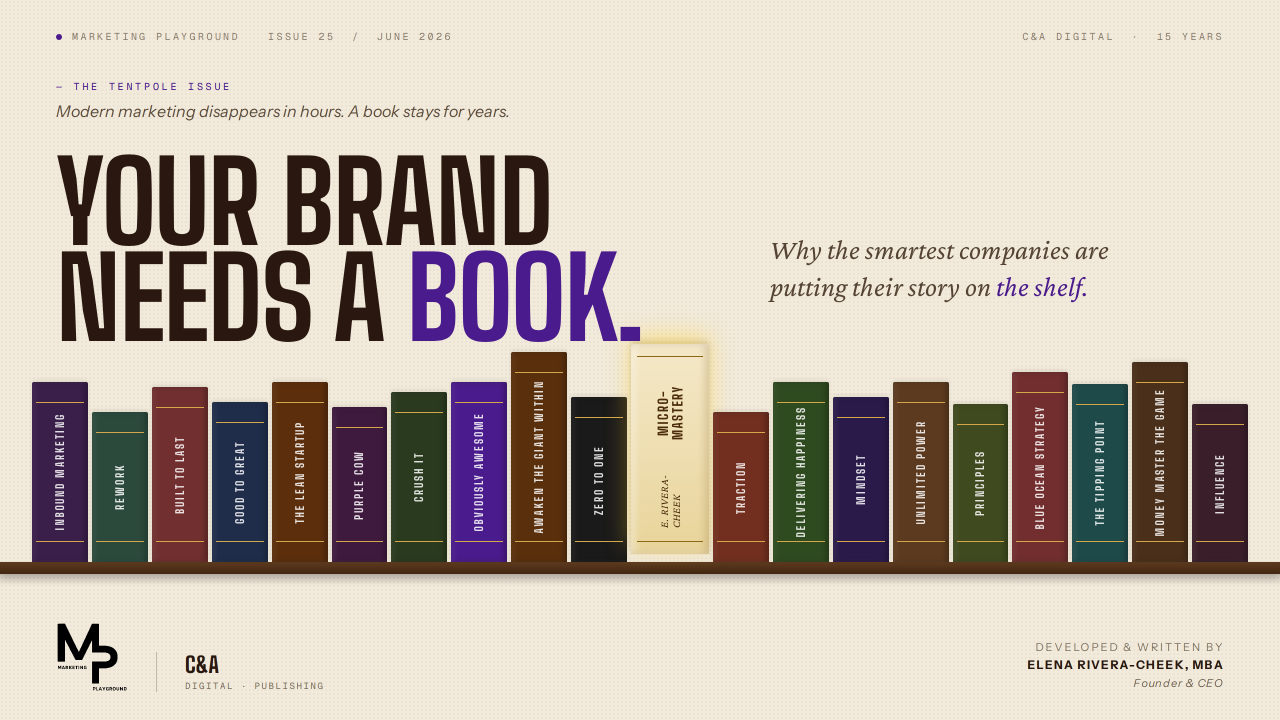
On June 18th — our fifteenth anniversary — we launched MICRO-MASTERY: The Authority Apex Strategy for Becoming the Only Choice in Your Market. Writing it did exactly what the data predicts. It clarified our positioning, sharpened our message, and opened opportunities that fifteen years of business hadn’t.
That experience is why C&A Publishing exists. For those who may not know, C&A Publishing is a division of C&A Digital built to help founders, executives, and organizations turn their expertise into published books that work as hard as any campaign — and last incomparably longer.
Our model is a straight fee structure. No royalties — your book is your asset, your intellectual property, and your revenue. We design beautiful, artful, engaging books, because how a book looks and feels is part of the authority it carries. We build the surround-sound platform to match: audiobook, e-book, and a dedicated microsite. And C&A Publishing is a Library of Congress Approved Publisher — your work is cataloged alongside the most credible voices in your field.
In a world where marketing disappears in hours, a book is the asset that stays. If your organization has a story worth telling — and it does — we would love to help you put it on the shelf.