
Welcome back to the Marketing Playground! This month, we are going to have a conversation that has been on my mind for a while — one that touches everyone who builds, leads, or hires in the marketing world.
Something has shifted beneath us. Not a trend and not a buzzword, but a structural change in what it takes to compete. If you have felt it in the way proposals are taking longer to close, or in the way clients are pushing back harder on fees, or in the sheer number of new competitors appearing out of nowhere — you are not imagining things.
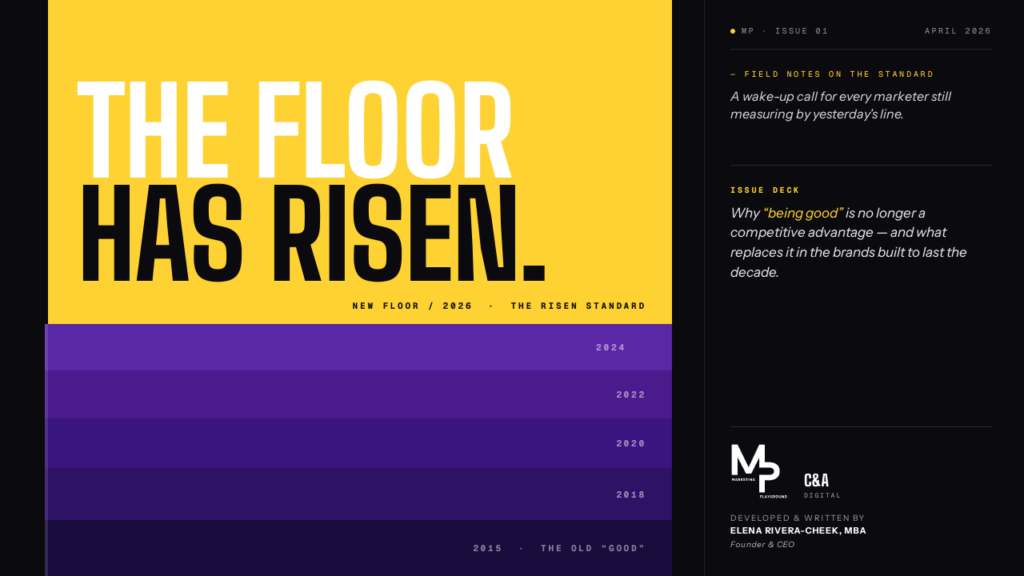
The floor has risen. And it is not coming back down.
What the Data Is Telling Us
According to McKinsey’s State of AI research, 71 percent of organizations now regularly use generative AI in at least one business function, up from 65 percent just a year earlier. Marketing and sales is consistently the function where gen AI is deployed most often. The barrier that once separated a seasoned agency team from a scrappy competitor — access to tools, production capacity, the sheer cost of delivering quality work — has eroded faster than most of us expected.
Meanwhile, 88 percent of in-house marketers now believe generative AI will replace some of the services agencies currently provide. And 60% of senior marketing leaders say they already spend less on agencies as a direct result of AI. These are not projections. They are the current operating reality.
What this means is simple: the baseline level of competence any firm can deliver has increased dramatically. A small team with the right tools can now produce research, strategy, content, and creative that once required a much larger bench and a much larger budget. Being capable is no longer rare. Being good is no longer a moat.
When the Buyer Cannot Tell the Difference
Here is where it gets uncomfortable. As the floor rises, the buyer’s ability to distinguish between firms based on capability alone collapses. If three agencies can all demonstrate competence in your category, the decision defaults to price, availability, or personal chemistry — none of which you can structurally control.
The 2026 Edelman Trust Barometer paints a parallel picture on the consumer side. In a market flooded with AI-generated content, audiences are retreating toward sources they already trust, narrowing their circles and becoming more skeptical of anything that feels manufactured or impersonal. Nearly half of Americans — 49 percent — reject the growing use of AI outright, compared to just 17 percent who embrace it.
The implication for marketers and agencies alike is the same: in a world where tools can produce credible work at scale, trust is the new differentiator. And trust does not come from showing that you can do the work. It comes from showing that you understand the world your client lives in better than anyone else.
The Question That Changes Everything
I have spent 15 years building C&A Digital, and I will be honest: this shift forced me to re-examine assumptions I had carried since the beginning. Assumptions about what clients were actually buying, about what made us valuable, and about where our real competitive advantage lived.
The answer was not in the range of services we offered or even in the quality of our output. It was in the depth of expertise we had built in a specific world — healthcare and complex communications — and in the authority that depth had earned us over time.
A competent firm gets considered. An authoritative firm gets chosen. That distinction has always been true, but the gap between the two has never mattered more than it does right now.
So here is the question I want to leave with you this month, the same one that changed how I run my own business: if the floor keeps rising — if being capable becomes table stakes for everyone — what are you building above it?
Next month we celebrate 15 years on the Marketing and Advertising Playground — and I have something to share about what comes next.
Until then, thanks for coming out to play.
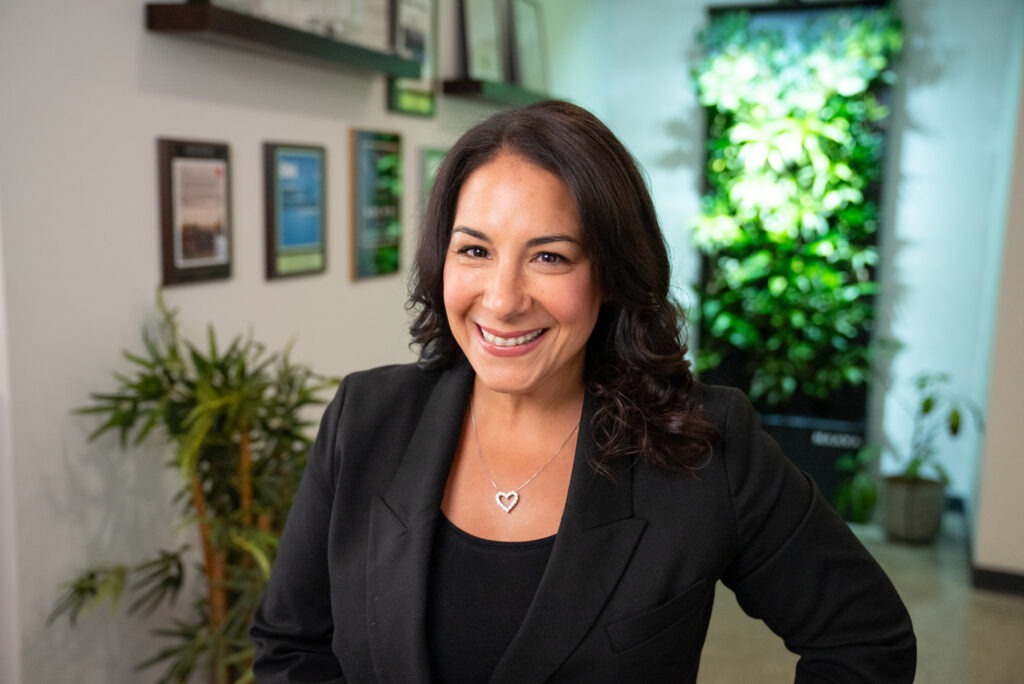
Elena Rivera-Cheek, MBA
C&A Digital CEO & Founder
Sources
- McKinsey & Company, “The State of AI in 2025: Agents, Innovation, and Transformation,” November 2025. https://www.mckinsey.com/capabilities/quantumblack/our-insights/the-state-of-ai
- MarketingProfs, “Will Gen AI Replace Some Marketing Agency Work?” 2026. https://www.marketingprofs.com/charts/2026/54222/will-gen-ai-replace-some-marketing-agency-work
- Edelman, “2026 Trust Barometer,” January 2026. https://www.edelman.com/trust/2026/trust-barometer
- Edelman, “Flash Poll: Trust and Artificial Intelligence at a Crossroads,” November 2025. https://www.edelman.com/trust/2025/trust-barometer/flash-poll-trust-artifical-intelligence

